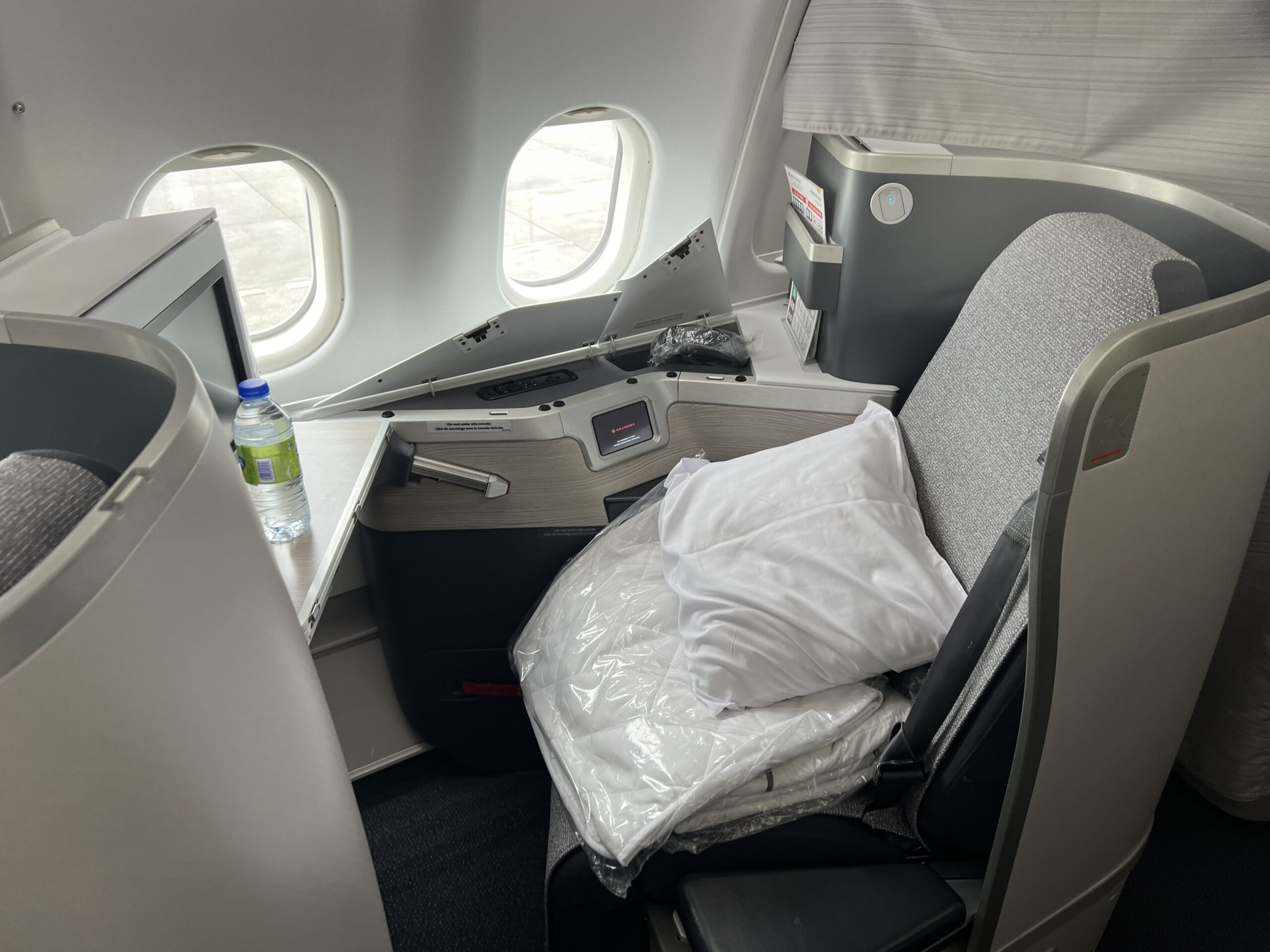
How I found United Polaris long-haul business award flights, saved 25,000 points by booking through a partner airline, and used flexible travel plans to make it happen.
Flying business class to Australia can be expensive. And when you’re looking at spending 14 hours on a plane, having a lie-flat seat, a little privacy, and the ability to get some actual sleep makes a huge difference.
I’ve managed to book business-class flights between the US and Australia multiple times using points, including United Polaris for just 75,000 Aeroplan points one way.
The interesting part? These were United flights, but I didn’t book them through United.
Instead, I used Air Canada’s Aeroplan loyalty program, which offered the exact same flight for fewer points. I found availability using Seats.aero, transferred points from my credit cards, and booked directly through Air Canada.
It wasn’t always straightforward. On more than one trip, I booked my flight to Australia without having a return flight secured. I had to be flexible with dates, airports, and sometimes even countries.
Here’s exactly how I made it work—and how you can use the same strategy.
What I Actually Paid for Business Class to Australia
I’ve used this strategy across multiple trips, and I kept my original booking confirmations.
Here are four of my business-class award bookings:
| Flight | Travel date | Aeroplan points | Taxes & fees (CAD) |
|---|---|---|---|
| United: San Francisco → Brisbane | March 2024 | 90,000 | C$105.80 |
| United: Brisbane → San Francisco | March 2024 | 75,000 | C$177.10 |
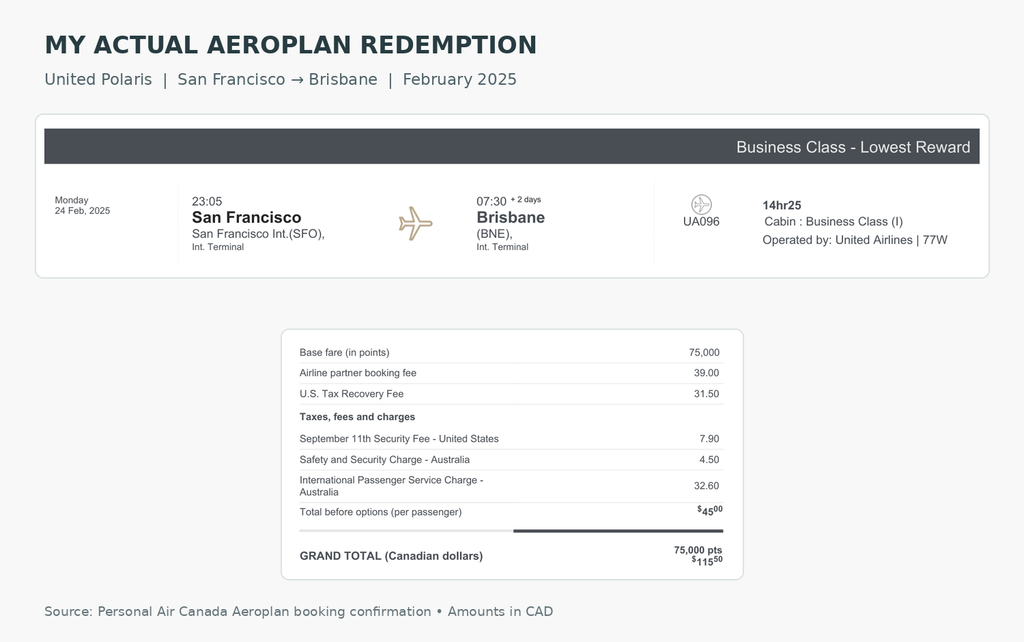
| United: San Francisco → Brisbane | February 2025 | 75,000 | C$115.50 |
| EVA Air: Taipei → San Francisco | April 2025 | 75,000 | C$119.20 |
My 90,000-point booking was a Flexible Reward fare, which offered more generous change and cancellation terms. The other three were booked as Lowest Reward fares.
For my February 2025 trip, I flew nonstop from San Francisco to Brisbane in United Polaris business class for 75,000 points plus C$115.50.
And these weren’t upgrades or waitlisted seats. They were confirmed business-class award tickets.
The EVA Air flight was part of a more complicated return journey. I purchased a separate economy flight from Bali to Taipei before flying business class from Taipei to San Francisco.
That’s an important distinction: sometimes the best redemption doesn’t get you all the way from your original departure point. You have to account for the cost of reaching the airport where the award flight begins.
The First Trick: Don’t Assume You Should Book Through the Airline You’re Flying
One of the biggest mistakes people make when booking award travel is assuming they should use the loyalty program of the airline operating their flight.
That’s not always the best deal.
United Airlines and Air Canada are both members of Star Alliance, which means certain United-operated flights can be booked using Air Canada’s Aeroplan points.
When I was searching for my Australia flights, I found the same United business-class flight priced at:
- 100,000 United MileagePlus miles
- 75,000 Air Canada Aeroplan points
Same flight. Same business-class cabin. Same destination.
The difference was 25,000 points for a one-way ticket.
For a round trip with comparable availability, that difference could potentially add up to 50,000 points.
That’s why I always compare partner loyalty programs before transferring points or booking.
There’s one important caveat: not every award seat available through an airline’s own loyalty program will also be available to its partners. And award pricing can change, so the prices I found aren’t guaranteed for future bookings.
How I Find Business-Class Award Availability With Seats.aero
I use Seats.aero Pro to search for award flights and set availability alerts.
Rather than searching individual dates on multiple airline websites, Seats.aero lets me monitor award availability across a much wider range of flights.
I pay for Pro because I want to search and set alerts well beyond the standard 60-day window, including flights many months into the future.
My Actual Seats.aero Alert Strategy
When I’m planning a trip to Australia or New Zealand, I don’t limit myself to a single airport.
Instead, I set alerts with the following criteria:
- Cabin: Business class
- Airlines: Star Alliance partners
- Departure and arrival regions: Major Oceania airports and West Coast US airports
- Maximum points: 100,000
- Dates: Flexible, with a broad travel window
This gives me far more opportunities than searching only San Francisco to Brisbane on one particular day.
I might find availability from Brisbane, Sydney, Melbourne, Auckland, or another airport—even if it isn’t the city where I’m currently staying.
I can then decide whether taking a short additional flight is worth it to secure the long-haul business-class seat.
My biggest tip: Search the region, not just the route.
The more airports and dates you’re willing to consider, the more opportunities you have to find a good redemption. There is also a benefit to being a solo traveler, as it is much easier to find single-seat availability vs. multiple.
Other Award Flight Search Tools Worth Considering
Seats.aero Pro is my personal choice for finding business-class award availability, and it’s the tool I used for the flights in this article. However, there are other award-search platforms worth exploring.
Roame is another option for searching award flights across multiple airline loyalty programs. Its paid plans include features such as flexible searches, searching across regions, and setting alerts when award availability appears.
point.me may appeal to travelers who are newer to booking flights with points. In addition to searching award availability, it offers step-by-step guidance to help users understand which loyalty program to book through and how to complete their redemption.
While I personally use Seats.aero for my searches and alerts, I’d encourage you to explore the different options and choose whichever works best for your travel style.
Regardless of which platform you use, always verify availability directly with the airline before transferring your credit card points.
What I Do When an Award Alert Arrives
When I receive an alert for a flight that works, I act quickly.
Here’s my process:
Step 1: Open the flight in Seats.aero.
I click through to Air Canada to look for the corresponding Aeroplan award.
Step 2: Verify the flight is actually bookable.
Award-search tools are incredibly useful, but availability isn’t guaranteed until you confirm it on the airline’s website.
I make sure the flight, date, cabin, and points price match what I’m expecting.
Step 3: Transfer my credit card points to Aeroplan.
I primarily accumulate transferable points using my Chase Sapphire Reserve and Chase Freedom cards, along with American Express. I also received a 150,000-point welcome bonus when I opened my American Express Platinum Card.
Both Chase Ultimate Rewards and American Express Membership Rewards can transfer points to Air Canada Aeroplan. Generally, they transfer at a 1:1 ratio but Chase frequently offers points bonuses for an additional 30%+
There are also multiple hotel programs that transfer to Air Canada as well, but the conversion rate may not be as favorable.
I deliberately don’t transfer points to Aeroplan before finding a flight.
Once points have been transferred into an airline loyalty program, you generally can’t transfer them back to your credit card program.
I’d rather keep my points flexible in case I find a better flight through another airline. This is simply a personal preference. If you regularly use a specific airline and don’t mind having your points tied up there, you may appreciate the ability to book without the additional delay.
Step 4: Book the flight as soon as the points arrive.
I’ve been fortunate not to lose one of these Australia award seats while transferring points, but I’ve seen desirable award flights disappear within a couple of hours.
There’s always some risk when transferring points after finding availability, particularly if the transfer isn’t instant.
For me, keeping my points flexible until I have a specific flight to book is worth that tradeoff.
Why Flexibility Was the Biggest Factor
Finding business-class availability to Australia is one challenge. Finding a return flight can be even harder.
For both of my Australia trips, I found outbound flights a few months before departure, but I didn’t necessarily have a return flight booked when I left.
I continued monitoring availability while traveling, and some return flights were booked only a few weeks before I needed to fly home.
That’s not a strategy I’d recommend to everyone.
If you have fixed vacation dates, limited time off, or absolutely need to be home on a particular day, leaving your return flight unbooked can be stressful and potentially expensive.
But because I had flexibility, I could consider options that someone with a rigid itinerary might overlook.
It is also worth noting that some countries, like New Zealand, require a return flight on arrival, so this strategy may not be feasible in some instances.
Why I Flew From Christchurch Back to Brisbane to Get Home
On my March 2024 trip, I was in Christchurch, New Zealand, but my business-class award flight home departed from Brisbane, Australia.
Instead of insisting on flying directly from New Zealand to the US, I purchased a separate flight from Christchurch to Brisbane for NZ$464.10 (before arriving in NZ).
That allowed me to catch my United Polaris flight from Brisbane to San Francisco, which I’d booked for 75,000 Aeroplan points plus C$177.10.
Yes, it meant additional travel and expense.
But it also meant I could fly the long-haul portion home in business class using a redemption I’d already secured. And spending a couple hundred dollars to save thousands on the long-haul flight was absolutely worth it.
When you’re looking at a flight of more than 13 hours, sometimes repositioning to another airport makes sense.
Of course, you need to account for the extra flight, baggage, potential hotel costs, and the risk of delays when traveling on separate tickets.
Another Return Flight Took Me Through Taipei
On a later trip, my return journey was even less direct.
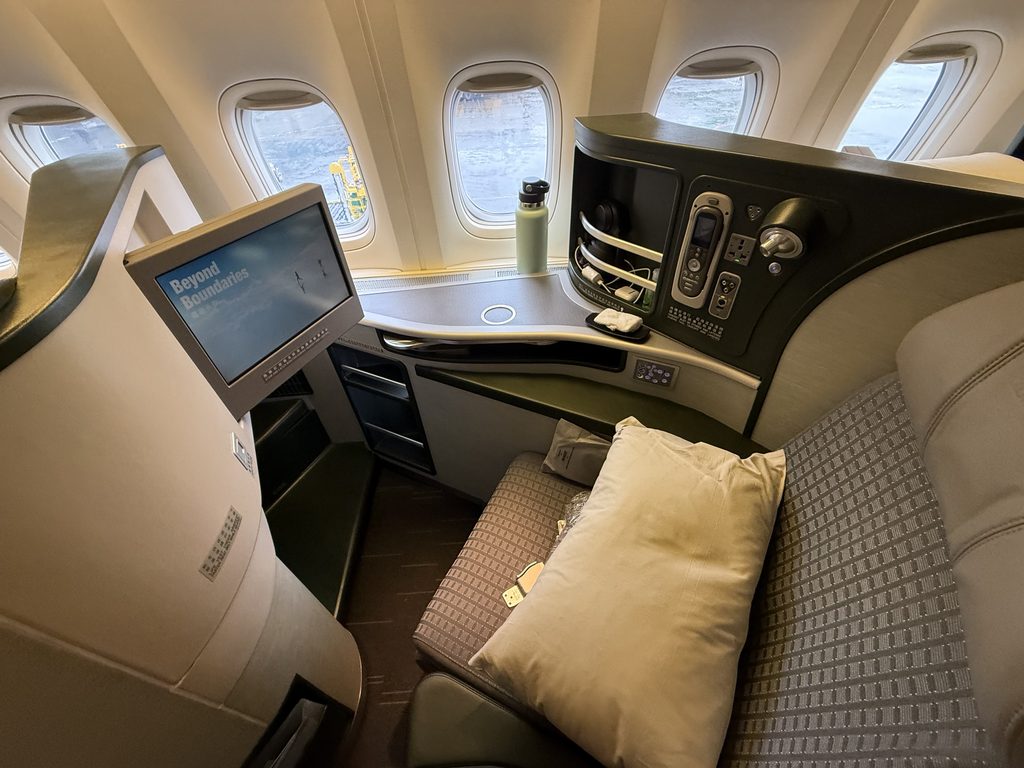
I purchased an economy ticket from Bali to Taipei and then used 75,000 Aeroplan points plus C$119.20 for an EVA Air business-class flight from Taipei to San Francisco.
It wasn’t the simplest way home, but it gave me another opportunity to use points for a comfortable long-haul flight.
That’s the advantage of monitoring multiple airlines and airports instead of waiting for one specific nonstop route.
This Strategy Also Worked for My Parents
Australia isn’t the only destination where I’ve used this approach.
I also found two business-class award seats for my parents traveling from San Francisco to Zurich on SWISS.
Both tickets cost 75,000 Aeroplan points each, even though the flights were operated by SWISS rather than Air Canada.
It’s another example of why I value transferable points and partner airline bookings.
The best redemption isn’t always through the airline whose name is painted on the plane.
Is United Polaris Business Class Worth It?
Personally, I love United Polaris.
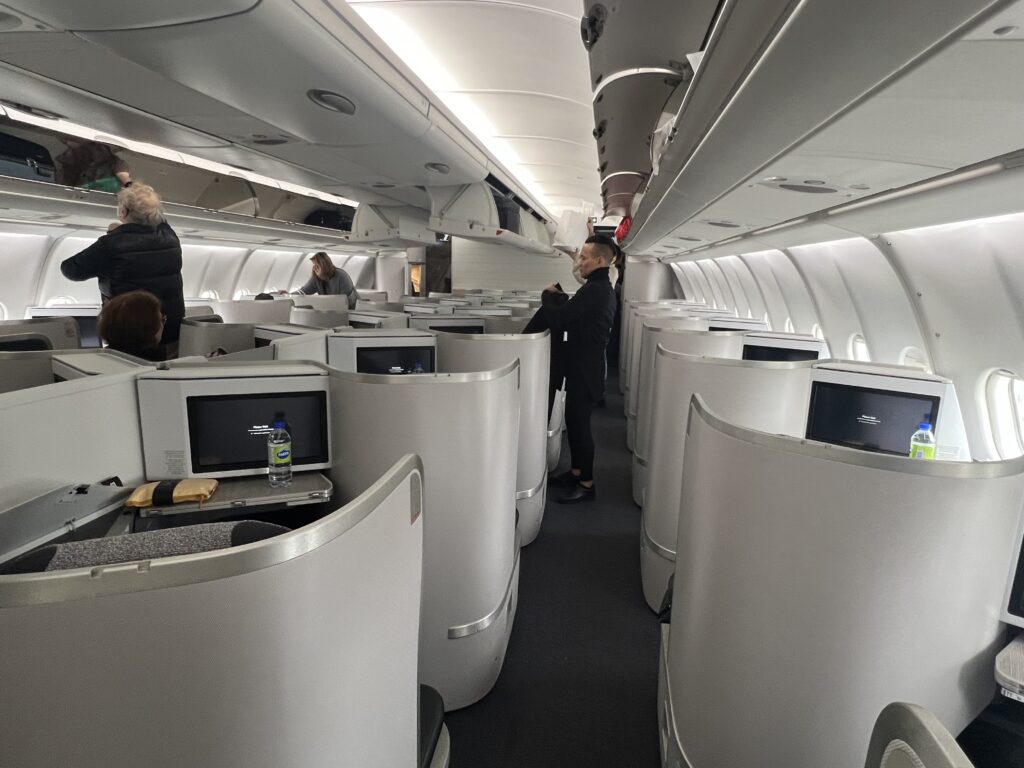
One of my favorite things about the cabin is the individual seating pods. I appreciate having a more private space rather than the more open, aisle-facing business-class layouts I’ve encountered on some other airlines. Or older-style business class cabins where you still have to climb over a neighbor to get to the aisle.
On a long overnight flight to Australia, that privacy makes a real difference.
I’ve also found the seats comfortable, although I’m fairly short, so I can’t speak to how well the lie-flat bed accommodates taller travelers.
I’ve had no major complaints about the food, and I particularly appreciate the ice cream sundae service offered for dessert on these routes.
For me, the biggest benefit is arriving after a long-haul flight feeling significantly more rested.
I love exploring once I reach a destination, and spending the first day recovering from an uncomfortable flight isn’t how I want to start a trip.
Would I pay thousands of dollars in cash for business class? Probably not.
But at 75,000 transferable points for a confirmed lie-flat seat to Australia, it’s an experience I’m happy to prioritize.
How to Try This Strategy Yourself
If you’re hoping to book business class to Australia or New Zealand using points, here’s what I’d recommend:
- Start earning transferable credit card points. Flexible currencies give you more booking options than accumulating miles with only one airline.
- Compare partner airline programs. Check whether the same flight is available through another Star Alliance loyalty program at a lower points price.
- Use an award-search tool. Seats.aero is the tool I personally use to find availability and set alerts. Roame and point.me are additional options worth exploring.
- Search multiple airports. Consider major airports throughout Australia and New Zealand, as well as alternative US arrival airports.
- Be flexible with dates. Even shifting your trip by a day or two can open up additional possibilities.
- Verify availability before transferring points. Confirm the actual award on the airline’s booking website.
- Act quickly when you find a good redemption. Premium-cabin award seats can disappear fast.
- Calculate the total cost. Include taxes, booking fees, positioning flights, and any extra accommodation before deciding whether a redemption is worthwhile.
One final consideration: award travel isn’t always the best use of points, particularly if you have to spend hundreds of dollars on extra flights or significantly change your itinerary.
I look at the overall value, not just the number of points.
Final Thoughts: The Best Award Flights Require Flexibility
I’ve now used this approach for multiple business-class flights across the Pacific, and the biggest lesson has been consistent.
The best award booking isn’t necessarily the most direct route or the first flight you find.
Sometimes it’s booking a United flight through Air Canada because the points price is lower. Sometimes it’s departing from Brisbane when you’re traveling in New Zealand. And sometimes it’s returning through Taipei because that’s where the business-class availability appears.
Using Seats.aero to monitor award availability, keeping my credit card points transferable, and being flexible with airports and dates has allowed me to enjoy business-class travel that I otherwise wouldn’t regularly pay for in cash.
And for someone who loves traveling but also loves getting good value, that’s exactly the kind of luxury worth chasing.
See you somewhere else,
Kelli
Award prices, availability, fees, and loyalty program rules can change. Always verify current details before transferring points or booking.
Disclosure: This article may contain affiliate links. If you subscribe or purchase through one of my links, I may earn a commission at no additional cost to you. All bookings and experiences described are my own. Award prices, availability, fees, and loyalty program rules can change.